AKBANK SANAT has been drawing attention to the activities that are shaping the modern art dynamics of our country since the day it was founded. With the Exhibition THE FAR/O/OTHER; works of the two significant representatives of the architecture world, TABANLIOĞLU ARCHITECTS and ARCHITECTS + HAN TÜMERTEKİN offices, joined to showcase their approach through selected projects.
Mainly focusing on the architect’s international works, the exhibition is curated by Prof. Dr. Hasan Bülent Kahraman and Luca Molinari is the consultant of the exhibition which takes place between 28 November 2018 and 05 January 2019 at Aksanat Gallery.
Tabanlioglu Architects’ housEmotion @Dubai Design Week 2018
housEmotion by TA_ responds the call of Dubai Design Week celebrating the universal power of design
Held under the patronage of HH Sheikha Latifa Bint Mohammed Bin Rashid Al Maktoum, Vice Chair of the Board of Directors, Dubai Culture & Arts Authority, Dubai Design Week is the largest creative festival in the Middle East, reflecting Dubai’s position as the regional capital of design. Design, arts and culture community of Dubai will see the works of ambitious designers, innovators and cultural bodies gather to celebrate the power of design and explore the role of design in our collective futures.
housEmotion
Tabanlıoğlu Architects explores the ambiguous question of where we belong. housEmotion looks like a house, but is it a home?
Tabanlıoğlu Architects’ installation considers the emotional meaning of home in an age of increasingly transient living. “There is a variety of perceptions of what home really is today,” the practice says. “The question ‘Where are you from?’ prompts myriad answers. The meaning of home for a person may simply be a smartphone with a full memory.” Or it may be something more fundamental to our sense of self – Tabanlıoğlu also reference the psychoanalyst DW Winnicott and his groundbreaking work on childhood development, Home is Where We Start From.
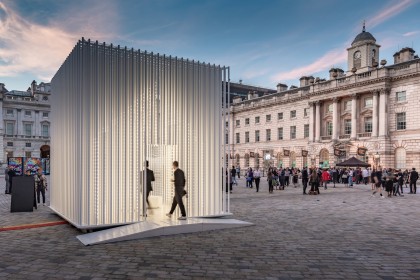
Tabanlıoğlu’s installation starts with the most elemental idea of a house: a cubic form. This is created using a series of white rods, a simple border demarcating the limits of the home. The gaps between the rods lend a semi-transparency to the structure, drawing visitors in but also allowing the home to dissolve into the wider environment. The walls, perhaps even the home itself, are seen to be illusory.
Once visitors step inside the structure, it again takes on the homely role of a shelter. A divan is placed in the heart of the space, which Tabanlıoğlu describe as being “like a mother’s lap”. It is a place where visitors will want to spend time, relax and meet new people. At night, lights embedded in the rods will turn the structure into a glowing lantern, or perhaps a warm hearth.
With kind supports of Nurus, Tepta, Osram and Debbas, HousEmotion was opened to visitors at Dubai Design District (d3).
Tabanlıoğlu Architects to represent Turkey at London Design Biennale 2018 with the thought-provoking installation housEmotion
London, UK – Responding to this year’s theme ‘Emotional States’, the Istanbul-based practice, Tabanlıoğlu Architects will represent Turkey at this year’s London Design Biennale 2018 with housEmotion. Open from 4 – 23 September, the installation explores the ambiguous question of where we belong and the emotional meaning of the home in an age of increasingly transient living.
‘housEmotion looks like a house, but is it a home?’
The pavilion starts with the most elemental idea of a house: a cubic form. Created using a series of white rods as a simple border demarcating the limits of the home. Gaps between the rods will lend a semi-transparency to the structure, drawing visitors in but also allowing the space to dissolve into the wider environment.
İnside, a comforting environment will be created for visitors to spend time and relax. A divan will be placed within the heart of the space, which Tabanlıoğlu describe as “like a mother’s lap”. At night, lights embedded in the rods will turn the structure into a glowing lantern.
Tabanlıoğlu also references the psychoanalyst DW Winnicott and his groundbreaking work on childhood development, Home is Where We Start From as an inspiration for housEmotion.
“There is a variety of perceptions of what home really is today. The question ‘Where are you from?’ prompts myriad answers. The meaning of home for a person may simply be a smartphone with a full memory, or it may be something more fundamental to our sense of self.” – Tabanlıoğlu Architects.
HousEmotion is supported by the Ministry of Foreign Affairs and the Ministry of Culture and Tourism of Turkey. The installation will be realized with the contributions of NURUS and TEPTA.
Tabanlıoğlu have previously participated in the London Design Festival. Tn 2015, the practice exhibited Transition, Hot / Wet in collaboration with Arik Levy at Somerset House. The installation combined different disciplines, creativities and materials. In 2016, Tabanlıoğlu presented their Beloved an installation at the Victoria & Albert Museum inspired by Sabahattin Ali’s novel ” Madonna in a Fur Coat”.
HousEmotion, located within the courtyard of Somerset House, will be open to visitors during the London Design Biennale, 4 – 23 September 2018.
The installation by Istanbul based office Tabanlioglu Architects points out to the question “where is home?” in this age of rapid and continuous change; with reference to psychoanalyst D.W. Winnicott “Home is Where We Start from”. The answer to the question “Where are you from?” indicates that almost no one physically stays in the origin and people accept a different place as “home”, either permanently or as guests. The frame of the installation embodies the limits of the “house”, creating a sense of control, where the semi-transparent walls gradually introduces into the outer environment. Tubes around the platform form the edges of the abstract house. Establishing a sense of border, compilation of the rods grant an optical illusion beside depth and openness. Founding a welcoming interior like a mother’s breasts, with the soft seating units, beyond the imaginary walls of the house, the structure becomes a shelter; developing self-interacts with the family and the larger society the “house”, with its simple form and minimalist design, ensures familiarity with compact neat details.
INTERNI, now in its 20th year (1998-2018) has been organizing the events under the guidance of Gilda Bojardi, during the ‘FuoriSalone’ in Milan. A lot more than a design ground, a global appointment that brands Milan unique and extraordinary, il FuoriSalone is a socio-cultural experience, composed of hundreds of events and shows scattered all over the city. And INTERNIbrings together a series of experimental and interactive installations of architecture and design, the results of collaboration between outstanding international designers and leading companies, institutions and startups.
The Atatürk Cultural Center (AKM) is located at the eastern end of Taksim Square in the heart of Istanbul. Not only is it one of Turkey’s most important cultural buildings, but also a prime example of modernist architecture in the country. Built in 1969 and renewed in 1977, it has stood abandoned for years now. The building’s multifaceted history serves as a catalyst to understanding modern Turkey, with political and technological developments reflected in AKM’s destiny.
The exhibition addresses the architecture and ongoing story of this cultural edifice in a kind of collage. This is composed of models and especially the many artifacts from the archives of Murat Tabanlioglu. Plans, photographs, letters, and mockups illustrate how history, function, and architecture are all intertwined. The plans for the AKM’s “re-composition” by Tabanlioglu Architects are also presented.
These shed light not only on the impact of the cultural center on the urban fabric, but also the challenges of designing a contemporary opera house that must operate like a complex machine. A key aspect is the preservation of the AKM’s architectural structure with its iconic façade. This issue touches on the wider debate on contemporary cultural preservation. While buildings from the 19th and 20th centuries are preserved and maintained in many places, modern buildings from the second half of the 20th century are often demolished – as has occurred in Germany with much of its postwar modernist architecture. In this regard, the AKM can be seen as an important case study.
Travels and accumulated memories of the architect can be considered “state zero” of architecture, in the case of Tabanlioglu Architects, a tradition extending to Dr. Hayati Tabanlioglu.
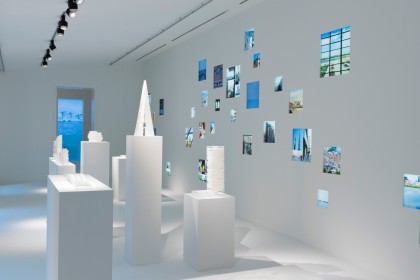
Layout of the exhibition space will follow the scenography which reveals the dichotomy; a selection of TA_’s work across the globe, and at the backdrop, the architect’s collected images from all around, all times and moods will come together to picture the inspiration.
Multiplicity of images of geographies, of architecture(s), of people and life will be re-visited through the lens of Murat Tabanlıoğlu. The influence of global architectural and urban works of today and the past, the patterns of life, nature, and man-made environment are the pieces of the travelogue.
Mutual interaction is inevitable. In this age of speed and communication, transitivity born out of interaction stands as a major consequence in architectural language as well, in a denaturalizing way or constructively.
The eye records and the architect diffuses the collected information and specific analysis in to the projects, like the bee “communicating” with the flower for co-evolution between the species.
Representing Tabanlıoğlu Architects’ projects at different stages,physical and abstract models, either formalor informal, will be a fragment of the exhibition align with the traveler’s images, which configures the stage zero, foundation of the architectural creation.
THRU, AN EXPERIMENTAL INSTALLATION CREATED IN COLLABORATION WITH LIGHTING AND FURNITURE ATELIER AQUA CREATIONS.
Commissioned by lighting specialist TEPTA to celebrate its 25th anniversary at the Istanbul Museum of Modern Art, Thru is part of “Day, Light, Night”, the first exhibition in Turkey to focus exclusively on lighting, showcasing nine different artworks and installations, curated by leading lighting designer Ulrike Brandi.
Thru concentrates the senses on the visual and reflective aspects, encouraging visitors to experience numerous perspectives through shifting streams of altering light and reflections. Designed by Tabanlıoğlu Architects as a compact 3.5 x 4.5m cube with 17 mirrored and 10 translucent silk panels hanging suspended and fractured throughout the space as though floating – Thru is a labyrinth to walk within and through. On entry, the main source of illumination emanates from the Aqua Creation pendant-like ‘Lucky Lamp’ at the centre of the installation which projects images from NASA explicitly focused on the theme “Day, Light, Night”. The illuminations propel the viewer deeper inwards while light diffuses through the slits between the panels and reflects up from the glazed floor. Seeking a playfully intense experience viewers are welcome to immerse themselves in the created daylight.
Inspired by the reflective capacity of a mirror to create numerous perspectives, Tabanlıoğlu Architects intends Thru to capture the viewer’s imagination via a mix of visual play, reflection and diffusion. Every step taken into Thru conveys a new surprise, with coincidental images illustrating the paradoxical narrative of “Day, Light, Night”, i.e. left becomes right, one becomes many. The silk fabrics of Aqua Creations, wrapped around the slight panelled frames materialize the wall of serenity while at the same time imposing a mildly lit atmosphere with a translucent glow.
About “Day, Light, Night “exhibition
TEPTA has organised a special light exhibition in honour of its 25th anniversary. The exhibition, at Istanbul Museum of Modern Art, will run through January 22, 2017.
The exhibition is organised to remark the importance of light in daily life and architecture. Invited artists, designers and architects apply their interpretations of natural light, by not imitating it but taking inspiration from it. Nine different installations and artworks take part in the exhibition, besides a two-day movie program and talk sessions on light and architecture.
The exhibition is organised with the patronage of the Consulate General of Italia in İstanbul. The exhibition venue is provided by the İstanbul Modern Museum.
The general idea for the installation is to design a conceptual “reading room” for Sabahhatin Ali’s novel, an ‘unconditional love” story, “Madonna in a Fur Coat”, one of the greatest novels in Turkish literature. The act of “reading” here refers to spatial experience, a juxtaposition of visual arts, literature and architecture.
Gallery 112 –the Bridge at the V&A, connecting medieval and renaissance galleries- is a distinct location in terms of using the advantage of passing through, granting the visitors a linear observation plan and an immersive experience.
The installation “Beloved” takes the form of a 13-metre-long mirrored black box, a physical representation to describe the themes of the novel with reference to the black notebook of the hero. Bridge works as a metaphor to describe the link between two dissimilar persons, a European new woman identity and an Eastern, timid young man in love, while bridging two cities, Berlin and Ankara.
Viewers peer inside through cracks in the surface, to witness the inner life of the main character using videos, text, light, and sound. Behind the slits in the shell, the life of the writer and the protagonist’s stories fragmented; moments of past and today, real and fiction are tied with an ethereal atmospheric soundscape. The slits of a lustrous object permits another way of seeing, indicating that the life of every person is fascinating, once “you look beyond the surface”.
The installation as a whole, is to celebrate architecture, design and literature, as well as the human condition, passion and intensity.
WITH A TEAM OF INTERNATIONAL CURATORS, ARTISTS AND CONSULTANTS
The exhibition at MAS in Antwerp was organized within the context of the Europalia Arts Festival 2015 and focused on the cities of Antwerp and Istanbul in their roles as port cities. Geographically, at least, both cities are located at frontier points of Europe: Antwerp is at the west end, by the Atlantic, and Istanbul is the threshold to the East, situated literally on the crossroads between Europe and Asia. Major quest of the curatorial process was to answer the question; “What does a port mean for a city?”. The narrative of the exhibition is based on discovering the relationships between the ports and their hinterlands by simultaneously highlighting Istanbul’s and Antwerp’s landmarks and maritime entities. Comprising works produced largely by young artists, the exhibition, in which objects are placed in a multimedia setting, explores what a port and the presence of water means for the two cities. Walking through Istanbul, a transit city in continual transition, THE exhibition aims to introduce alternative views of the two cities, redefined by artists’ points of views, enriched with archaeological objects and historical material. The digital works appear on the inner walls of the light, white construction, an abstraction of Istanbul’s shoreline.
PARALLEL PRESENCE OF LIGHT AND LIQUID
In September 2015, Istanbul based Tabanlioglu Architects was thrilled to have been chosen to showcase their installation with Arik Levy at the inaugural Somerset House 10 Designers in the West Wing at London Design Festival 2015. Planet Earth is a unison of endless combinations of forms of countless materials, yet water and light are the essence of being. Transition; Warm/Wet, a duo-installation in collaboration with ARIK LEVY & TABANLIOGLU ARCHITECTS, refers to the endless interaction of the matter, particles, and all entities. Solid Pool’s random moves of sharp split-plates, rising on the ground cause unpredictable response of water drops, vertically inverted the FractalCloudWarm draws endless planes in space with no beginning and no end. just like walking in to the sun itself, the super bright light turns in to a warm tangible material to walk through. The juxtaposition of the installation to that by Tabanlioglu Warm meets Wet, Earth meets Sky, at the transition point where notes of endlessly spinning sounds emerge.
Sponsored by VitrA
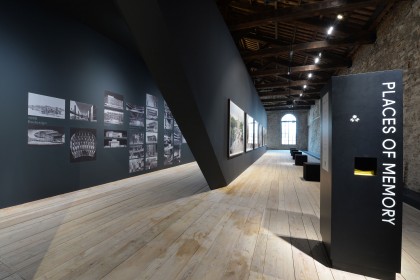
“PLACE/SPACE” AND “MEMORY” FORM THE TITLE AND CONTENT OF THE EXHIBITION, AND MARK A BEGINNING, IN THE NEW SPACE.
In 2014 Turkey acquired a permanent space at the biennale for the next 20 years, Places of Memory, curated by Murat Tabanlıoglu, has been the first exhibition of the national pavilion, so we had the chance to express our architectural and urban approach at the Venice Biennale International Architecture Exhibition. The concepts “place/space” and “memory”, that form both the title and content of the first International Architecture Exhibition mark, in a sense, a beginning, as the first step taken in this new space. Designing the exhibition space and the context of the first Pavilion of Turkey at the Venice Biennale 14th International Architecture Exhibition, as in architectural production, our preferred method had been to approach the project as a natural process that develops with contributions, although it began to take shape from the first sketches on, and through consideration of all data we had gathered. Following the assessment, we invited five architect/artists. Along with the governing idea of “architecture, not architects”, specifically underlined within 2014’s general theme, we kept in step with the guidelines of the exhibition via individual perception, narration and remembering, and we sought to coincide our viewpoints with different views. In fact, we prioritized the establishment of a platform in which contributors to the exhibition formed the inner circle, yet in addition to that, intended to bring together everyone’s memories and documents, as architecture is not only an aesthetic stratum, it has its place, and evolves within the structure of life.
A film installation covering a selection of 19 projects are identified as “Media”, “Boulevard”, “Culture” and “Beyond”, a retrospective, indeed, an immersive ‘3D’ video installation produced by Japanese visual artists WOW. Instead of the conventional way of presenting architectural work that has always been though models, plans, sections and other tools, to reveal the projects through a different eye, an artistic eye looking at the architectural production, the exhibition avoided the usual means of reproduction, preferring the digital visualization of architectural space that offers viewers the ability to fly through and within high resolution, far-reaching, immersive projected images. ANOTHER PERSPECTIVE show many different viewpoints from unique angles. The architecture is deconstructed to reveal elements that the casual visitor to these sites would not have realize existed. Three gigantic screens surrounding the audience allow them to experience a virtual taste of Tabanlioglu works.
THE INSTALLATION PRODUCED TO CELEBRATE THE RIBA INTERNATIONAL AWARD 2011 FOR LOFT GARDENS PROJECT.
As it is the first time that a project and architect from Turkey is awarded the prestigious RIBA Prize, under the patronage of Council General Mrs. Jessica M. Hand, the event is realized at Pera House. The RIBA International Awards reward the excellent work being done by RIBA members around the world since 2005. These are for buildings outside the EU by RIBA Chartered Architects and RIBA International Fellows. In 2011 Loft Gardens (Istanbul, Turkey) project has been one of the 13 winners of the International Awards for architectural excellence The Royal Institute of British Architects (RIBA). During the event, the first release of the video installation took place, focused on the lives in Loft, as if peeping through CCTV into the lives of the residents, prepared by the artist-duo :mentalKLINIK. As in Loft, an arrangement of private and common spaces in consonance with social requirements accomplished within the context of architecture and artistic expression, with an intimate feedback of how to live in harmony, reviving the vanishing ritual of having reliable neighbors as good friends, in the standards of “contemporaneity”. Moreover, with its potential of transformation, Loft plants the seeds of a “social sculpture” to grow with the creative contribution of people living there.
Hannover Expo 2000 Turkish Pavilion is designed in such a way that Turkey’s contemporary outlook, which is based upon the country’s vast ancient heritage, can be reflected onto the visitor in a very short time. The building’s design principle is to create an image of Modern Turkey via simple and distinct architectural elements. Recent trends in the world prove an architectural concept that is mainly characterized by high technology, light and transparent construction techniques, natural materials, and transformable buildings. The very same philosophy has formed the basic design principle of the Turkish Pavilion. The building, in fact, is just a simple, transparent technological blanket that encapsulates the continuity in the Anatolian cultural heritage and symbolizes the ongoing journey from the traditional to the technological.
Expo 2000 Turkey Pavilion is conceived as a conceptual exhibition, which aims to reflect Turkey’s image in a “human” axis that both transverses and unites the elements of nature-technology, east-west and past-future. This ‘human’ axis will be perceived in a cosmogonies and mythological universe that is built up of elements like love, enthusiasm, passion, fate, eternity, spirituality, etc. throughout the exhibition. The whole Pavilion, in one sense, is contemplated as a conceptual map of intelligence and emotional universe of the Anatolian men.